Monday, October 17, 2011

Out and About

Since my last post in September, I attended a 2-day workshop called "Regenerative/Radical Urban Sustainability Training" that featured the cultivation of mushrooms as a means of cleaning up toxic soil (mycoremediation), composting, keeping chickens in a city neighborhood, and aspects of solar greenhouse construction, among other topics.  If I've totally confused you with my description, this may help clarify: radixcenter.org

As luck would have it, this training was held in Albany, so I took it as an opportunity to network a bit.  Though there were not as many locals at the workshop as I expected, I did manage to connect with a staff member from Capital District Community Gardens, a longstanding non-profit that manages 46 community gardens and operates a produce market on wheels called the Veggie Mobile.  I've been invited to spend a day on the Veggie Mobile as it makes stops in neighborhoods with limited produce options.  I also met a pair of young women who are managing a new community garden in North Troy, which is across the Hudson River from Albany.  When they heard that I was in the midst of a biodynamic agriculture internship that has involved working with children, they expressed interest in getting together with me at a later date.  I'm hoping to reconnect with them when I'm in Albany during my winter break.   I figure it's better to start making connections now than waiting until I move to Albany permanently next April.  Being an intern is fun, but I haven't forgotten that I need to find a job in a town where I know no one other than my husband when the internship ends.

Shortly after returning from the workshop, I spent an evening in Manhattan at an exhibit hosted by Megan Evans, an Australian artist, whose honeybee-focused works were inspired by the  philosophy of Ron Breland, the "radical" beekeeper I mentioned in an earlier post.   Ron was present at the tiny gallery space along with one of his dodecahedron hives.  He spoke of the hive as a body and likened the opening of it to invasive surgery.  Megan stated that she would like to see honey be thought of something so valuable that it is given away rather than sold.  When I considered her comment along with Ron's, I concluded that honey is the "blood" of the hive body as it nourishes the bees the way our blood nourishes our cells.  Blood was the only thing I could think of that is so valuable that we donate it rather than sell it.  I shared my thoughts with Ron and he seemed to truly appreciate the analogy.  To view some of the pieces in the exhibit, click here: http://boxofficeprojects.com/Current.html


Here's Intern MaryAnn checking out 3 beds covered with oats, peas, and vetch
The New Zealand clover undersown around this chard
has been replenishing the soil.

Of course, we've also been busy in the garden.  With the passing of the autumnal equinox, there's been plenty of work to do getting the nearly 70 beds ready for the colder months ahead.  Cover crops of rye, oats, peas, and vetch, and also that lovely crimson clover I featured in an earlier post, have been planted to protect and nourish the soil over the winter.  We're still harvesting kale, lettuce, Asian greens, peppers, and parsley for the farmstand.  Thinking ahead to snowier times, spinach and chard seeds have been sown in the greenhouse with the hope that we'll be able to enjoy those leafy greens throughout the winter.   With morning temperatures in the 40's lately, those snowy days are not too far off.  The horses have grown thicker coats in preparation; I have my layers of warm clothing at the ready.

Sending you warm thoughts on a chilly evening...thanks for reading.

Thursday, September 15, 2011

Winding Down

The move to Albany was completed just in time for the monthly biodynamic gardening workshops that The Pfeiffer Center allows me to attend for free.  September has brought a shift from hands-on experience to more classroom-style learning and also the clearing of the garden spaces.  Gone are the zucchini, cucumber, and tomato plants and their trellises that filled much of the summer landscape.  The basil is starting to get a bit moldy from the longer, cooler nights as we move closer to the autumnal equinox, and the butternut squash is ready to harvest.

We have about a dozen fruit trees, including apple, pear, peach, and quince.  Unfortunately, the woodchucks, squirrels, and chipmunks have been snacking on much of the fruit.  Below is a photo of some apples I picked earlier this week:


These came off the tree with the bites already in them.  I particularly like the two neat puncture marks created by the woodchuck's incisors on the middle apple.

I mentioned earlier that we've been checking the hives to see if the bees have enough honey stored for the cold and flowerless months ahead.  Late August examinations showed inadequate supplies so we checked them again yesterday.  The decision was made to combine some of the weaker hives with stronger ones and also to start feeding "bee tea" to those hives that do not have enough stored honey to get them through the winter.  This tea is a sort of syrupy mixture of honey, sugar, water, thyme, chamomile, and other herbs that is placed in a jar with tiny holes in its lid.  The jar is then set in the hive where the bees dip their tongues through the holes to drink it.  This allows them to continue making honey when flower nectar is in limited supply or simply no longer available; it will be provided to the bees weekly until November.

In the process of checking the hives, I was finally stung by one of the bees.  The stinger was squarely planted in my forehead, in the space just above and between my eyes (This is sometimes called "the third eye", the gate that leads to inner realms of higher consciousness).  It's a strange place to be swollen and itchy, but I'm keeping the scratching to a minimum and hoping for some spectacular enlightenment. 


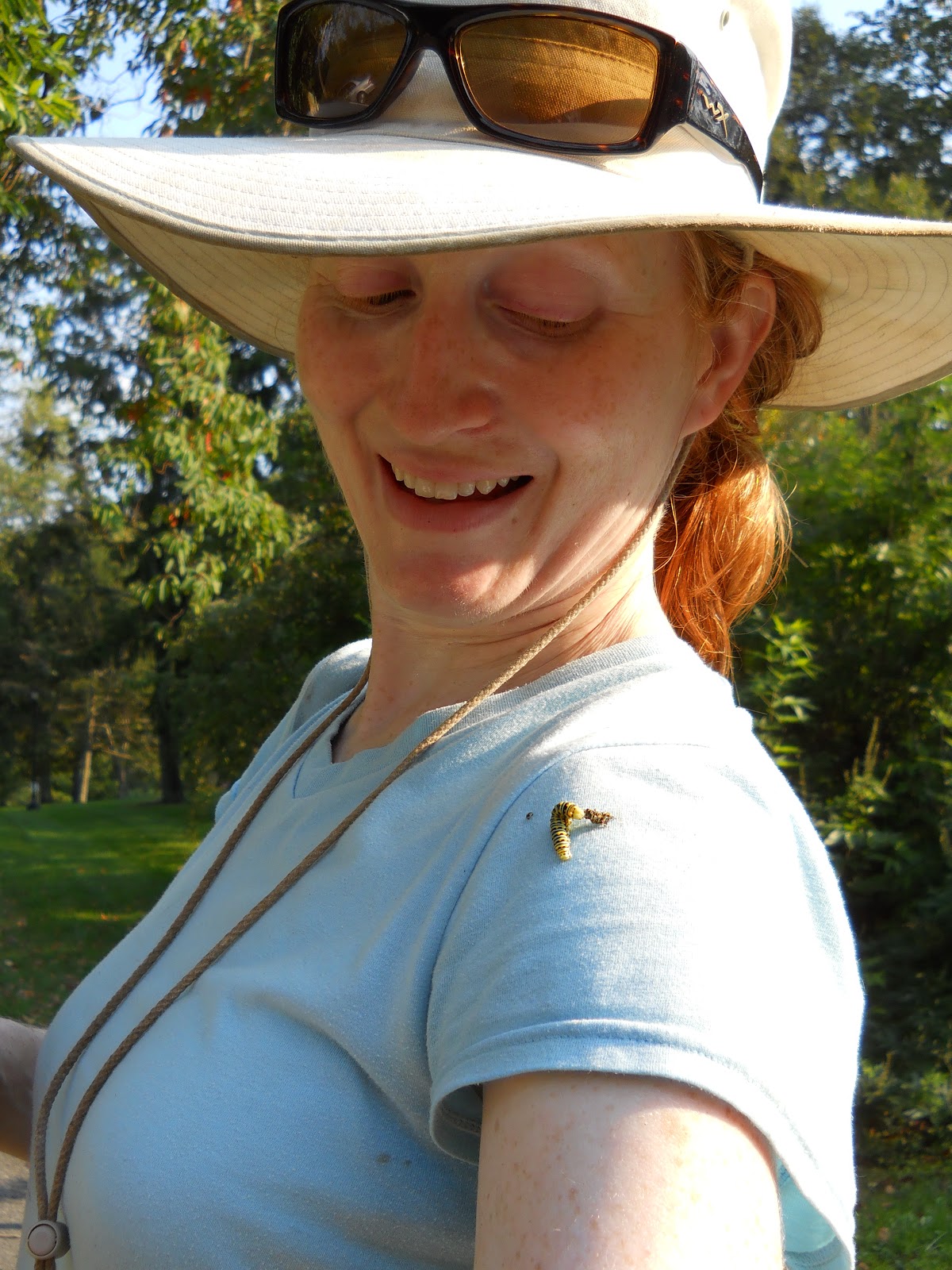
I must say I was a bit awestruck by this swallowtail butterfly caterpillar's decision to shed his skin while traveling on my sleeve.  That's not something you see everyday, and especially not on your shoulder.  I'm guessing that it was getting ready for hibernation.  

Speaking of hibernation, it's time for to me to have my temporary session, so I'll sign off for now.  Have a good night.

Saturday, September 3, 2011

Cores, Skins, & Cobs

In those August highlights, I forgot to mention that the interns spent a couple of mornings up the road at the Fellowship Community helping them process their harvest.  The Fellowship is an intentional community that focuses on the care of the elderly; it is surrounded by a farm that provides food for the "members" (residents) and "co-workers" (staff) as they are called.  We helped peel, core, juice, and can about 500 pounds of tomatoes the first morning.  The second morning found us stripping nearly 300 pounds of corn kernels from the cobs for freezing.  Josh's girlfriend Mary was visiting from California that week and she joined us for this food processing extravaganza.  Her artistic contribution is pictured below:

I'd like to see the tomato fish swimming in a sea of basil.

Friday, September 2, 2011

Looking Northward

Sorry for the delay.  Moving from DC to Albany took up most of my weekends last month, so there wasn't much time for blogging.  I'll be gone again this weekend because the moving truck will be arriving in Albany tomorrow afternoon.  Which do you think is easier, packing or unpacking?

August highlights

  • The Pfeiffer Center covered the registration fee for the Northeast Organic Farming Association's 37th Annual Summer Conference at the University of Massachusetts-Amherst, so I was able to spend 3 days learning about cover crops, using mushrooms to clean up toxic waste, school and community gardens, the Farm Bill, and other interesting topics.  This allowed for some good networking opportunities too.


  • Fellow intern MaryAnn and I visited Amawalk Farm in Katonah, NY and learned about growing raspberries and the best-looking salad greens you've ever seen.  Westchester friends- the greens are sold in food co-ops around the county and they taste just as good as they look.
  • I harvested the baby pan pumpkins that I helped plant in May.  Fellow intern Josh has already made a couple of pies with them.  I'm surrounded by bakers here and loving it.
  • I spent more time with the bees.  Here's a photo of Elexis and me examining a frame.  Since summer is winding down, we've been checking the hives to make sure the bees have enough honey stored for their winter food supply.

Of course, there's been plenty of harvesting, weeding, and planting succession crops.  We're now discussing what will be in the garden next year and which beds to use.  This is quite challenging as there are many variables to take into account: which crops were previously grown in a bed, amount of sun/shade, air flow, pests, etc.  I have a map of the garden that I've filled in with my ideas, in pencil.  The eraser will most likely be gone before I finish this project.

Though my fair skin has often made me feel rather fragile next to the other interns who are sporting tank tops and shorts while they work, I'm pleased to have made it through the summer without getting burned.    Insect bites and stings are another story however: I'll spare you the story of the wasp in my pants.

Hope you've had a good summer too.  Best wishes for a relaxing Labor Day weekend!

Thursday, July 21, 2011

Dodeca-what?

Check out these unique dodecahedron (12-sided) hives I visited today.  They were created by Ron Breland, who has been called "the most radical beekeeper in Rockland County".  We all agreed he's the most warm and friendly radical any of us have ever encountered.  The bees really seem to like him too:

Sunday, July 17, 2011

Bugged

My apologies for the lack of photos in this post.  I'll try to add some later.

We did a check of the hives last week.  I hadn't been involved in much beework recently, so it was a nice change of pace.  The hive known as "Satisfaction" had been without a queen for a month, which was cause for concern.  In order to encourage to the worker bees to create a new queen, comb from another hive containing eggs and larvae were placed in Satisfaction along with some nursemaid bees.  I had the task of firmly, yet carefully, knocking the nursemaids into the hive.  This involves raising the wooden frame, which is covered with bees, several inches above the hive and then bringing it down decisively on the edge of a frame still in the hive.  The impact sends most of the bees on the frame you're holding down into the hive and once you've done it, you step back quickly.  I did this twice with good results.  As I sometimes find myself to be an indecisive person, working with the bees is a good exercise in behavior modification.  You need to be clear in your actions and not hesitate when working with bees: they do not like indecisiveness.

Today I went to a screening of "Queen of the Sun", a documentary on bees that I've been trying to see for months: http://www.queenofthesun.com/about/  It was shown at Shadowcliff, a beautiful old mansion overlooking the Hudson River in Nyack, NY that is the current headquarters for the Fellowship of Reconciliation, a non-profit that's been promoting non-violence since 1914.  It also happens to be the office of film director Jonathan Demme ("The Silence of the Lambs", "Philadelphia", "Rachel Getting Married").

"Queen of the Sun" looks at the dangers honeybees are facing around the world, much of which is due to commercialization.  For example, in central California there are thousands upon thousands of acres of almond trees that require pollination every year in order to produce nuts.  Because there are just almond trees in these orchards that only bloom in February, bees cannot make a home there year-round.  This lack of local bees means that thousands of bees are trucked in from all over the country in order to tend to the almond blossoms.  These traveling bees struggle with temperature/environmental changes,  eat corn syrup while in transit since they can't forage for food, and are at increased risk of contracting diseases and parasites: all of which makes the hives quite vulnerable.  But the bees who are not exploited in this way are also in jeopardy: exposure to pesticides disrupts their ability to find their way back to their respective hives and may be a cause of Colony Collapse Disorder, a mysterious occurrence where entire bee colonies suddenly disappear.  Since bees are necessary for vegetables and fruits to grow, there is much at stake if they are not protected.  If you eat honey, buy local!  If you want to help bees, plant flowers!

Bees were not the only insects on my mind this past week.  The theme of the day camp was "What Bugs You?" so Josh and I did some sessions with the children that focused on insects such as ants, butterflies, ladybugs, and flea beetles, in addition to the bees.  Some of the campers are wary of the bees in the garden, but most are intrigued by the numerous 6-legged creatures that call the garden their home...much as I was at the same age.  Bugs rule!

Sunday, July 10, 2011

Of Cabbages and Queens

Though the regular garden maintenance and day camp sessions were in full swing last week, the interns were able to take time for some educational activities.  As part of its commitment to intern training, The Pfeiffer Center participates in the Collaborative Regional Alliance for Farmer Training (CRAFT) of the Lower Hudson Valley, which provides new farmers with opportunities to learn what is happening at other farms in the area every other Tuesday evening.

While many of the farms are located in more rural settings, some are in or around New York City.  Our host this past Tuesday was Brooklyn Grange, a 1-acre rooftop farm that, despite the name, is not located in Brooklyn, but rather in Queens.  Situated on top of a large, 6-story industrial building, this unique agricultural enterprise sold 12-13,000 pounds of vegetables to local restaurants, its 25-member CSA, and at farmers' markets last year.  The rooftop-specific soil used for the vegetable beds is made from mushroom compost and special lightweight stones, so it looks a bit strange but the plants don't seem to mind.  Drainage mats, felt, and special fiber mats located beneath the soil work to manage water dispersal on the roof in conjunction with 16 drains.  Though it's quite a remarkable feat,  sustainability may be a challenge as it is difficult to keep replenishing the soil when you have load-bearing issues to consider: it took 1 million pounds of soil just to establish the farm.  Nevertheless, it was a beautiful evening.  Elexis, Josh, Kirstin, and I meandered about the heirloom tomatoes, beets, chard, sunflowers, salad greens, and okra and enjoyed the sunset along with the cool breezes on the rooftop.  www.brooklyngrange.org
Looking over the edge between beds 1 and 0.  Note beds -1 and -2 to my right.
This is due to the lopsidedness of the building


Wednesday afternoon found me pulverizing chopped and shredded green cabbages in an earthenware crock with a potato masher in order to break down their cell walls so they could magically become sauerkraut.  I have never made anything fermented before so it was interesting to see the packing of the salted cabbage into mason jars using the leftover cores and leaves to create a sort of seal at the top of the jar which will keep the cabbage from rising above the brine and potentially spoiling.  We'll shake it occasionally and then check it in about 2 weeks.  Head Gardener Megan will be giving a workshop on food preservation techniques on July 30; this was a technical rehearsal for that event.  I have to say that I did feel like I was getting in touch with my Polish heritage with this activity.  Looking forward to preparing horseradish next...